Pages

Showing posts with label What is Massage. Show all posts

Sunday, May 20, 2018

What is Massage? Part 4c: Muscle Tissue


The main tissue associated with, and manipulated by, massage is MUSCLE. The gorgeous, elastic power-houses that produce movement and make horses the athletes they are. Hold on tight because this is going to be a very detailed post about this amazing tissue.

There are three types of muscle tissue:  
 
Smooth
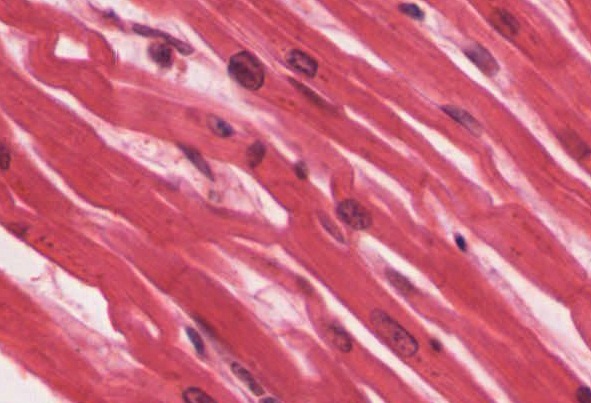
Cardiac
Smooth tissue supports the epithelial tissue surrounding blood vessels and hollow organs. Cardiac tissue is a very specific tissue that makes up most of the heart’s bulk. Both of these tissues are involuntary, meaning they are not easily influenced by anything other than hormonal or chemical changes.

Skeletal
Skeletal tissue is the only voluntary type of muscle tissue and the most easily manipulated. It is influenced mainly by the nervous system and the skeletal muscles come in a variety of shapes and sizes. As discussed in the last post, a muscle has two tendons: and origin and an insertion. Between those tendons is what is called the belly.
(Hourdebaight, 27)

The belly is where the action of the muscle happens. It is made up of bundle of fibers. Nerve impulses cause the muscle fibers to react and fold over themselves causing the belly to contract which moves the skeleton.

These fibers are classified by color and contraction speed. Fast-twitch white, fast-twitch red, and slow-twitch red.


Fast-twitch white is low in myoglobin, a red protein that carries and stores oxygen, and most easily fatigued. Muscles with a higher ratio of white fibers are best suited to sprinting or sports that have sudden, short bursts of speed and anaerobic activity.
t3athlete.com/blog/2016/8/15/training-for-speed-developing-fast-twitch-muscle-fibers
Slow-twitch red is high in myoglobin and not easily fatigued. Muscles with a higher ratio of red fibers are best suited to endurance racing or sports with long, aerobic activity.

Horses also have fast-twitch red fibers which land between fast-white and slow-red in terms of resistance to fatigue. In humans, these fibers are very rare.
Genetics determine the ratio of white to red fibers and, therefore, what job a horse is best suited for. Quarter Horses have a higher white to red ratio and so are best for cutting, roping, and reining jobs which require them to chase after sporadically moving cattle. Arabians have a higher red to white ratio and are best suited for long slower travel over many miles.

Contraction happens when a muscle is stimulated by the nervous system. There are three types of contraction: concentric, eccentric, and isometric.
Concentric and eccentric contraction are what we recognize as movement. Concentric pulls a bone to move it, eccentric acts against concentric to stabilize the bone’s movement. So, while one muscle concentrically contracts, the opposing muscle slowly releases in eccentric contraction. Usually the muscles are situated on opposite sides of the bone or joint they are acting upon. The gif below shows both.


Isometric contraction occurs when the muscle contracts but no movement is seen, like when pushing against an immovable object. There is no shortening or elongation of the muscle during this type of contraction. You can see this happening when a horse is riding in a trailer attempting to keep its balance or when trying to pull a heavy load like in draft horse pulling competitions.

Muscles contract in groups with many muscles acting on one bone or joint. The muscle performing concentric contraction during movement is called the agonist, the muscle performing eccentric contraction is called the antagonist. Synergists are muscles that assist the main agonists and antagonists of a given group.

Muscles are divided by either their proximity to the skeleton, or the joints they affect.

There are the superficial muscles:
(Hourdebaight, 28)
These muscles are the outer most layer of muscles, the furthest from the skeleton. They are easily seen when a horse is moving. You can also see some of the planes of fascia in the image on the far left, pictured as the white areas.


These are the deep muscles:
(Hourdebaight, 36)

 These muscles are between the superficial and the extremely deep muscles that hold the spine together. Most of these are the largest in the body and hold the most power. They are harder to affect, but not impossibly so.


And congratulations. You have made it through some very difficult and complex information. It can be overwhelming if you try to absorb it all at once, so I suggest you read the posts multiple times and refer back to them with future posts. The next post will be on different massage techniques.

Thursday, May 10, 2018

What is Massage? Part 4b: Connective Tissue


This post is going to be short. The following post which will be on muscles and their fibers, therefore, very long and I did not want to overwhelm anyone with and overload of technical information.

The next tissue in our series is connective. It connects the skeleton and muscular systems and over all holds the body together.
There are three types of connective tissue: Ligaments, Tendons, and Fascia. They are all made out of collagen, but each are different densities.

Fascia:
(Color Atlas, plate 15)


Fascia is a very recent discovery. Well, not discovery, it has been there forever. It has been around for as long as animals have had muscles that needed to slide easily over each other. For a long time, no one knew what it was or did, so during surgeries doctors would remove and discard the “white film” that covered the muscles before suturing the animal/person back up. Now, however, studies have found that it is a massive web-like tissue that winds its way around everything in the body. It varies in density and can be superficial (between the skin and muscles) or deep (wrapping around and covering some deeper muscles from view). Fascia holds it all together, like a huge spiderweb holds flies, except not as icky.

Ligaments:
(Hourdebaight, 24)


Ligaments are a very strong connective tissue that hold the bones of the skeleton together:
(Hourdebaight, 22)
They wrap around joints and help protect from abnormal range of motion, sudden strain, and torque. These bands are made of collagen fibers and are the least flexible of the connective tissues so they can hold their shape. They have minimal blood flow which hinders their ability to heal when injured, which, in severe cases may need to be fixed surgically. 
A rule of thumb of rest for recovering ligaments is one month for every letter in the word: L-I-G-A-M-E-N-T= 8 months.


 Tendons:
(Scott, 18)
As shown, tendons connect muscles to bone. They are dense fibers very similar to ligaments. They have high tensile strength that allows them to endure large amounts of tension. The muscle attached usually cannot produce enough force to rupture its tendons, so they do not tear easily and it can be devastating when they do. They are not as elastic as muscle fibers, but are more so than ligaments. They also have limited blood flow, but more so than ligaments. 
Therefore, they heal more quickly than ligaments, but not as quickly as muscle. 
T-E-N-D-O-N= 6 months.


Each muscle has two tendons: the origin and the insertion. The origin connects to the least moveable bone, and the insertion connects to the most moveable. The muscle acts on the two tendons to bring the insertion towards the origin.

Friday, February 23, 2018

What is Massage? Part 3: Hard Tissue


This going to be a post full of detailed information, so there is a TL;DR at the end for those who would prefer it.

Two of the aforementioned definitions of massage mention “soft tissue”; which brings to mind the bits of paper used to wipe noses during a cold and, unless you are inclined to remember high school or college biology in detail, nothing more than a fleeting “oh yeah!”.

Tissue is used in medical terms to describe just about every part of the body that is permanent. There is soft and hard tissue. Hard tissue is - you guessed it - bone. Soft tissue is everything else.

Since massage is the manipulation of soft tissues, we will mostly be focusing on those. However, muscle acts on the hard tissue- the bones and joints- to create movement, and since the skeleton is the physical base of the body, it will help to have a basic understanding.

This is your horse’s skeleton:


As you can see, there are many different shapes of bones and each has a specific task to perform or muscle group to support. The four categories of bone are flat, long, short, and irregular.


The Scapula (#9) is a very easily found flat bone. It is the bone that sits on both sides of the withers and is very important to saddle fitters.


A long bone offers structural support and a multitude of bony prominences to which tendons and muscles can attach. Pictured is the Humerus (#10).
Other long bones include the radius (#11), femur (#23), tibia (#25), and the cannon (#14).


At the end of the cannon bone, are three short bones: the long pastern (#16 or PP), the short pastern (#17 or MP), and the coffin (#19 or DP). These make up the rest of the leg from the fetlock to the hoof. 

Also pictured here are a few irregular bones, which, as their name states, have an irregular shape. These are called the sesamoid (sez-moy-d) bones. The proximal sesamoid bones (#15 and PSl + PSm) sit behind the fetlock and support important tendons and ligaments that help with shock absorption. The distal sesamoid bone (#18 and DS) goes by a well-known name in the horse world: the navicular bone.


Other well known irregular bones are those that make up what is called the Axial Skeleton:
 Or the spine.

These are called vertebrae and they protect the spinal column.


As you can see, there is quite a lot of variation.


So, these are your basic bone shapes which allow for varied muscle attachments and movements. 

TL;DR- There are four shapes of bones (flat, long, short, and irregular) and each shape has different muscles attached for support and movement.